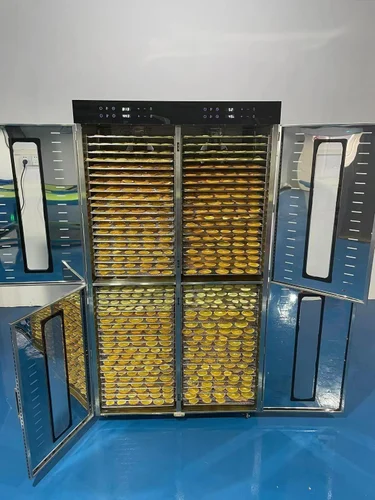
Industrial Food Dehydrator Machine for Business: Price, Features, Capacity & Complete Buying Guide
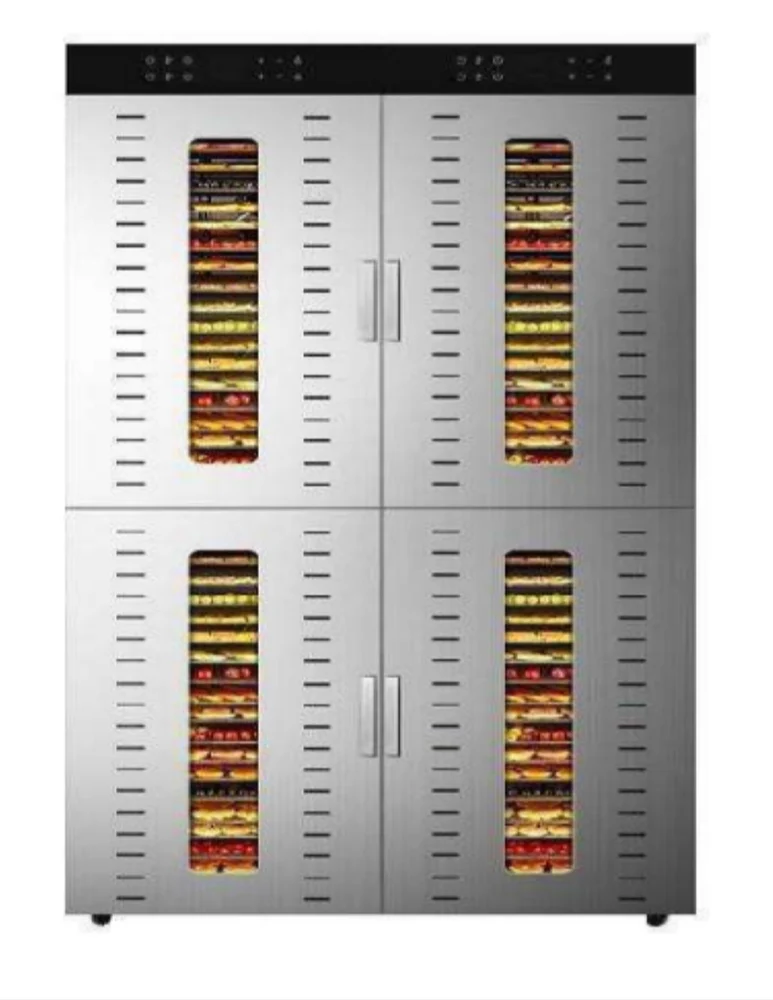
The food-processing industry offers exciting opportunities for entrepreneurs who want to manufacture dried fruits, vegetables, herbs, spices and convenient food products. As businesses explore value-added food production, industrial drying equipment has become an important investment for improving production capacity and product consistency.
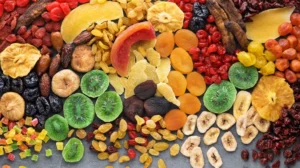
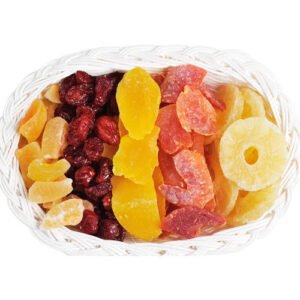
An industrial food dehydrator machine helps businesses remove moisture from food under controlled conditions. It can be used to manufacture dried mango, banana chips, apple slices, pineapple, vegetables, herbs, spices and many other food ingredients.
From small food-processing startups to large manufacturing facilities, the right dehydration equipment can support commercial production, wholesale supply, private-label manufacturing and export-oriented businesses.
However, choosing machinery requires more than comparing purchase prices. Businesses must evaluate drying technology, production capacity, energy consumption, construction quality, automation, maintenance and the final product specification.
In this comprehensive guide, we will explore everything you need to know about selecting an industrial food dehydrator machine for business, including machine types, pricing factors, working principles, features, production costs, business opportunities and buying tips.
1. What Is an Industrial Food Dehydrator Machine?
An industrial food dehydrator machine is specialised food-processing equipment designed to remove moisture from food products using controlled drying technology.
It generally uses heat, airflow, humidity management or vacuum-based processes to reduce the moisture content of food.
Compared with traditional sun drying, industrial dehydration equipment provides a more controlled processing environment and can support larger production volumes.
Businesses use industrial drying systems to manufacture:
- Dried mango
- Banana chips
- Dried pineapple
- Dried apple
- Dried papaya
- Dried strawberries
- Dried blueberries
- Dried coconut
- Dried tomatoes
- Dehydrated onions
- Dried garlic
- Vegetable flakes
- Dried herbs
- Spice ingredients
- Fruit powders
- Speciality food ingredients
An industrial food dehydrator machine is suitable for businesses that require repeatable drying processes, planned production schedules and consistent product specifications.
The appropriate equipment depends on the food material, production volume, required texture, moisture target and available investment.
2. How Does an Industrial Food Dehydrator Machine Work?
Industrial dehydration equipment removes moisture from food through controlled processing conditions.
In a typical hot-air system, heated air circulates around food products, absorbs moisture and carries it away from the drying chamber.
Step-by-step working process
Step 1: Raw material selection
Select fresh, suitable-quality fruits, vegetables, herbs or other food materials. Remove damaged, spoiled or unsuitable items.
Step 2: Washing and cleaning
Clean the raw materials using appropriate food-grade washing and sanitation procedures.
Step 3: Peeling, cutting and preparation
Prepare the food according to the finished product requirements. Uniform slices or pieces generally help improve drying consistency.
Step 4: Pre-treatment
Some products require pre-treatment to manage colour changes, oxidation, texture or other quality characteristics.
Step 5: Loading
Place the prepared food on suitable trays, racks or conveyor belts according to the manufacturer’s loading instructions.
Step 6: Drying programme
Set the appropriate temperature, airflow and processing time. The programme should be developed for the specific food product.
Step 7: Moisture removal
The drying system removes moisture until the product reaches the required specifications.
Step 8: Cooling and inspection
Cool the finished product under hygienic conditions and inspect its appearance, texture and moisture characteristics.
Step 9: Packaging
Pack the dried food in suitable food-grade packaging to protect it from moisture and contamination.
The drying time and temperature depend on the product, initial moisture, piece thickness, loading density and desired final characteristics. One universal drying programme is not suitable for every food.
3. Types of Industrial Food Dehydrator Machines
Different drying technologies are available for commercial and industrial food processing. Selecting the correct technology is important because each system offers different investment, production and product-quality characteristics.
A. Industrial tray dryer
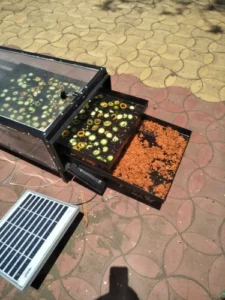
An industrial tray dryer contains multiple trays arranged inside a drying chamber. Heated air circulates through the chamber to remove moisture.
Suitable for:
- Dried mango
- Banana slices
- Apple rings
- Pineapple pieces
- Vegetables
- Herbs and spices
Advantages:
- Suitable for batch production
- Flexible for different food products
- Relatively straightforward operation
- Available in different capacities
- Suitable for small and medium manufacturers
B. Industrial hot-air dryer
An industrial hot-air dryer uses controlled heating and air circulation to process larger quantities of food.
It may include insulated chambers, industrial fans, adjustable airflow and digital controls.
Suitable for:
- Commercial dried-fruit manufacturing
- Vegetable dehydration
- Food ingredient production
- Bulk processing operations
C. Heat-pump food dehydrator
A heat-pump dehydrator uses refrigeration-based technology to transfer heat and manage moisture removal.
Depending on the design and operating conditions, it may provide controlled drying conditions and improved energy efficiency compared with some conventional systems.
Suitable for:
- Quality-focused food processing
- Products requiring controlled drying
- Businesses seeking to manage energy consumption
Buyers should compare actual energy consumption and drying performance under equivalent operating conditions.
D. Industrial freeze dryer
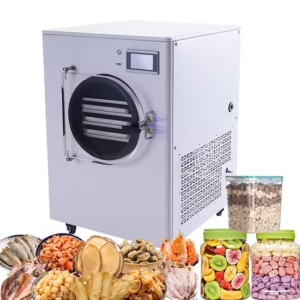
Freeze drying involves freezing the food and removing ice under vacuum through sublimation.
It is commonly used for premium food products where a lightweight, porous structure and distinctive texture are required.
Suitable for:
- Freeze-dried strawberries
- Freeze-dried mango
- Freeze-dried pineapple
- Freeze-dried vegetables
- Premium fruit ingredients
- Instant food ingredients
Freeze-drying equipment generally requires a higher investment and more specialised operation than conventional hot-air drying.
E. Industrial conveyor dryer
A conveyor dryer moves food products through drying zones on a continuous belt.
It is designed for businesses that need high-volume or continuous production.
Suitable for:
- Large food manufacturing plants
- High-volume fruit processing
- Vegetable dehydration
- Standardised food ingredient production
F. Vacuum food dehydrator
A vacuum dryer removes moisture under reduced pressure. The lower operating pressure can allow moisture removal under conditions different from conventional atmospheric drying.
Suitable for:
- Selected heat-sensitive food products
- Specialised ingredients
- Products requiring particular texture or quality characteristics
The choice of technology should be based on product trials, equipment specifications and production economics.
4. Industrial Food Dehydrator Machine Price and Investment
The industrial food dehydrator machine price varies according to capacity, technology, automation, material quality and manufacturing specifications.
A compact batch dryer may require a relatively modest investment, while a large continuous production line or industrial freeze dryer can require substantially more capital.
The following are broad illustrative budgeting ranges for preliminary planning in India. They are not live supplier quotations or verified prices for particular models.
| Machine category | Indicative investment range |
|---|---|
| Small commercial tray dryer | ₹35,000–₹1,50,000 |
| Medium industrial tray dryer | ₹1,50,000–₹5,00,000 |
| Large industrial cabinet dryer | ₹5,00,000–₹15,00,000+ |
| Industrial heat-pump dryer | ₹3,00,000–₹20,00,000+ |
| Industrial conveyor dryer | ₹10,00,000–₹50,00,000+ |
| Industrial freeze dryer | ₹20,00,000–₹1 crore or more |
| Customised industrial drying plant | Project-specific quotation |
Actual prices may fall outside these ranges depending on equipment configuration, capacity, imported components, automation, installation and supplier terms.
Factors affecting equipment cost
- Production capacity
- Number and dimensions of trays
- Drying technology
- Stainless steel grade
- Heating system
- Fan and motor specifications
- Temperature and humidity controls
- PLC automation
- Insulation quality
- Installation and commissioning
- Warranty and after-sales service
What should a machinery quotation include?
Before purchasing an industrial food dehydrator machine, request a detailed written quotation covering:
- Machine model and technical specifications
- Fresh input capacity
- Expected finished output
- Power consumption
- Material specifications
- Electrical requirements
- Installation costs
- Freight and taxes
- Warranty terms
- Operator training
- Spare parts and maintenance support
Do not compare machinery only by purchase price. Consider the total installed cost and long-term operating expenses.
5. Important Features of an Industrial Food Dehydrator Machine
A good industrial dryer should match your production requirements and provide reliable operation.
1. Food-grade construction
Food-contact surfaces should use suitable food-grade materials. Stainless steel such as SS 304 is commonly specified for food-processing applications.
Confirm the material grade of the chamber, trays, racks and other food-contact components.
2. Uniform airflow
Uniform air circulation helps reduce variations in moisture removal across the drying chamber.
Poor airflow may cause uneven drying and inconsistent finished products.
3. Adjustable temperature settings
Different food products require different drying conditions. Choose equipment that provides a suitable operating temperature range and accurate temperature control.
4. Digital control panel
A digital controller allows operators to manage temperature, time and other available process settings more conveniently.
5. PLC automation
Industrial systems may use programmable logic controllers to manage operating sequences and repeatable drying programmes.
6. Energy-efficient heating system
Heating and fan operation contribute to production expenses. Compare measured energy consumption per batch and per kilogram of saleable finished product.
7. Proper insulation
Good chamber insulation can help maintain stable operating conditions and reduce unwanted heat loss.
8. Easy cleaning
Removable trays, accessible surfaces and hygienic construction make cleaning and maintenance easier.
9. Safety controls
Check for suitable electrical protection, over-temperature protection, emergency controls and safe operating procedures.
10. Reliable technical support
Availability of spare parts, installation support, operator training and after-sales service is essential for commercial production.
6. Industrial Food Dehydrator Machine Capacity
Capacity is one of the most important factors when choosing food dehydration equipment.
A machine that is too small can limit business growth. An oversized machine may increase investment and operating expenses before the business has enough orders.
| Business category | Suggested equipment approach | Main application |
|---|---|---|
| Startup | Small batch dryer | Product testing and initial sales |
| Small manufacturer | Medium tray dryer | Regular retail production |
| Growing business | Large cabinet dryer | Wholesale and private-label production |
| Medium industrial plant | Multiple dryers or larger batch system | Higher production volume |
| Large manufacturer | Conveyor or integrated drying line | Continuous production |
Fresh input capacity vs dried output
One important point is that advertised machine capacity may refer to the weight of fresh food loaded into the machine, not the weight of the final dried product.
Fresh fruits and vegetables contain varying amounts of water. The finished weight depends on:
- Initial moisture content
- Desired final moisture
- Peeling and trimming losses
- Seed removal
- Product variety
- Drying efficiency
- Sorting and rejection losses
For example, a machine capable of processing 100 kg of fresh fruit per batch will not necessarily produce 100 kg of dried fruit.
Request a product-specific drying trial and confirm expected saleable output.
7. Industrial Food Dehydrator Machine for Different Products
An industrial food dehydrator machine can support several product categories, provided the equipment and drying process are suitable.
| Food product | Common preparation | Potential commercial application |
|---|---|---|
| Mango | Slices or strips | Dried fruit snacks |
| Banana | Slices | Banana chips |
| Apple | Rings or slices | Breakfast ingredients |
| Pineapple | Rings or chunks | Packaged fruit snacks |
| Papaya | Cubes or strips | Snack mixes |
| Strawberry | Halves or slices | Cereals and toppings |
| Coconut | Slices or shreds | Bakery and snack products |
| Tomato | Halves or slices | Food ingredients |
| Onion | Slices or flakes | Seasonings and food manufacturing |
| Garlic | Slices or pieces | Spice ingredients |
| Carrot | Slices or flakes | Instant food products |
| Spinach | Leaves | Vegetable powders and ingredients |
| Ginger | Slices | Food ingredient processing |
| Herbs | Leaves | Seasoning and herbal products |
The same equipment may process different products, but product changeovers require appropriate cleaning, preparation and validated drying programmes.
8. Industrial Food Dehydrator Machine vs Traditional Sun Drying
Sun drying has been used for centuries, but commercial food manufacturers often require more predictable processing conditions.
| Feature | Traditional sun drying | Industrial food dehydrator |
|---|---|---|
| Drying source | Sunlight and ambient heat | Controlled drying technology |
| Weather dependency | High | Lower |
| Temperature control | Limited | Available in suitable systems |
| Airflow control | Limited | Designed airflow system |
| Production planning | Weather-dependent | More predictable |
| Batch consistency | Can vary | More controllable |
| Large-scale production | May be difficult | Suitable systems available |
| Initial investment | Usually lower | Higher |
| Process monitoring | Often manual | Can be automated |
Industrial drying can improve process control, but it does not replace food-safety procedures. Raw-material hygiene, validated processing, moisture testing and suitable packaging remain essential.
9. Electricity Consumption and Operating Cost
The purchase price of an industrial food dehydrator machine is only one part of the investment.
Electricity, labour, raw materials, packaging, maintenance and quality testing all contribute to production expenses.
Electricity cost calculation
Use this formula:
Electricity cost per batch = Average power consumption (kW) × Operating hours × Electricity tariff per kWh
Illustrative example:
- Average power consumption: 8 kW
- Operating time: 10 hours
- Electricity tariff: ₹8 per kWh
Estimated electricity cost:
8 × 10 × ₹8 = ₹640 per batch
This is an example calculation, not a guaranteed machine consumption figure. Actual electricity use depends on heating cycles, insulation, product load, ambient conditions and machine design.
Other production costs
| Expense category | Examples |
|---|---|
| Raw materials | Fresh fruits and vegetables |
| Labour | Washing, cutting, sorting and packaging |
| Energy | Electricity, gas or other heating source |
| Packaging | Pouches, cartons and labels |
| Quality control | Moisture and laboratory testing |
| Maintenance | Repairs, cleaning and replacement parts |
| Logistics | Transportation and warehousing |
| Compliance | Licensing, documentation and audits |
How to calculate production cost per kg
Use the following formula:
Production cost per kg = Total batch production cost ÷ Saleable dried output in kg
Always calculate using the finished saleable output, not the fresh input weight.
10. How to Start a Food Dehydration Business
An industrial food dehydrator machine can support different business models, from a small packaged snack brand to a large food ingredient manufacturing operation.
Step 1: Select your business model
Decide whether you want to manufacture branded dried foods, provide contract drying services, sell bulk ingredients or manufacture private-label products.
Step 2: Conduct market research
Study demand from supermarkets, food retailers, wholesalers, bakeries, restaurants, online customers and food manufacturers.
Step 3: Select your product range
Start with a manageable product range based on local fruit and vegetable availability.
Possible products include dried mango, banana chips, dried pineapple, dried apple, dehydrated onions and dried vegetable ingredients.
Step 4: Calculate raw-material requirements
Estimate fresh food availability, seasonal pricing, preparation losses and expected drying yield.
Step 5: Select appropriate machinery
Choose equipment based on product type, fresh input capacity, finished output, energy requirements and expected production volume.
Step 6: Arrange the processing facility
Plan dedicated areas for raw-material receiving, washing, preparation, drying, cooling, packaging and finished-product storage.
Step 7: Complete regulatory requirements
Identify applicable food business registration, licensing, labelling and food-safety requirements before commercial production.
Step 8: Develop packaging and branding
Create packaging suitable for your target customers, distribution channels and product shelf-life requirements.
Step 9: Build sales channels
Consider:
- Retail stores
- Online marketplaces
- Your own e-commerce website
- Wholesale distributors
- Food ingredient suppliers
- Private-label customers
- Export buyers
Step 10: Monitor production economics
Track raw-material cost, drying yield, energy use, labour, packaging, quality failures and customer demand.
11. Food Safety and Quality Control
Food safety is essential for every commercial food-processing operation.
A drying machine alone cannot guarantee that a finished product is safe or shelf-stable. The complete processing and packaging system must be appropriately managed.
Important quality-control measures include:
- Inspection of incoming raw materials
- Hygienic washing and preparation
- Clean food-contact surfaces
- Foreign-material control
- Suitable temperature monitoring
- Validated drying procedures
- Moisture and water-activity testing
- Microbiological testing where required
- Suitable cooling procedures
- Protective packaging
- Batch traceability
- Appropriate storage conditions
Important food-safety considerations in India
Food businesses should identify applicable FSSAI registration or licensing requirements and follow relevant regulations for manufacturing, processing, packaging and labelling.
Businesses targeting international buyers may also need to meet destination-market requirements and customer audit standards.
Potential food-safety management systems to investigate include:
- HACCP-based food-safety systems
- ISO 22000
- Good Manufacturing Practices
- Buyer-specific quality standards
The exact requirements depend on the business activity, product and market.
12. How to Choose the Best Industrial Food Dehydrator Machine
Selecting the correct machinery requires a practical evaluation of both technical specifications and commercial requirements.
Questions to ask the manufacturer
- What is the fresh food input capacity per batch?
- What is the expected finished output for my product?
- What is the average electricity consumption?
- What stainless steel grade is used?
- Is airflow uniform across all trays?
- What is the operating temperature range?
- Does the machine have digital or PLC controls?
- Can the manufacturer conduct a product trial?
- What is the warranty period?
- Are spare parts readily available?
- Does the supplier provide installation and training?
- What is the total installed price?
Machinery purchase checklist
-
Identify the food products you want to manufacture.
-
Estimate daily fresh-food processing requirements.
-
Calculate expected dried output.
-
Select an appropriate drying technology.
-
Confirm machine capacity.
-
Check food-contact material specifications.
-
Compare energy consumption.
-
Request a product trial.
-
Review warranty and service support.
-
Confirm installation requirements.
-
Obtain a detailed written quotation.
A successful equipment purchase should be based on actual production requirements rather than advertised capacity alone.
13. Business Opportunities with Industrial Food Dehydration Equipment
Food dehydration equipment can support several commercial opportunities.
A. Dried fruit manufacturing
Process fresh fruits into packaged dried fruit products for retail and wholesale customers.
B. Dehydrated vegetable production
Manufacture dried onions, garlic, carrots, tomatoes and other vegetable ingredients for food manufacturers.
C. Contract food processing
Offer dehydration services to farmers, food brands, ingredient suppliers and other businesses.
D. Private-label manufacturing
Produce dried foods for retailers and companies that sell products under their own brands.
E. Wholesale food ingredient supply
Supply bulk dried fruit and vegetable ingredients to bakeries, snack manufacturers, restaurants and food-processing companies.
F. Export-oriented manufacturing
Explore international demand for dried fruits, vegetables and speciality ingredients, subject to import regulations, quality standards and documentation.
G. Food-processing machinery services
Businesses with engineering expertise may explore equipment fabrication, maintenance, installation, automation and spare-parts supply.
The commercial viability of each opportunity depends on raw-material availability, product quality, manufacturing cost, distribution and customer demand.
14. Industrial Food Dehydrator Machine Maintenance
Regular maintenance helps keep food-processing equipment operating reliably.
Daily maintenance
- Clean trays and food-contact surfaces.
- Remove food residue from the chamber.
- Check the condition of fans and filters.
- Inspect electrical controls.
- Record operating temperatures and process information.
Periodic maintenance
- Inspect heating elements.
- Check fan motors and bearings.
- Examine door seals and insulation.
- Verify temperature sensors.
- Inspect electrical connections.
- Replace worn components as required.
Long-term maintenance planning
Follow the manufacturer’s recommended maintenance schedule. Keep essential spare parts available and train operators to identify unusual noises, airflow problems and temperature variations.
A documented maintenance programme can help reduce unexpected downtime and improve production planning.