Freeze Dryer Machine Price: Complete Buying Guide for Business, Industry & Food Processing
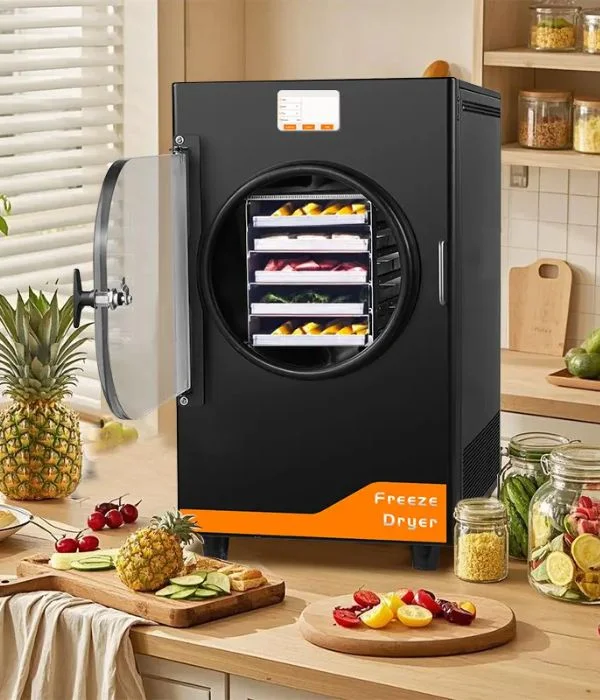
Freeze-dried products are gaining attention across the food, pharmaceutical, biotechnology and speciality ingredient industries. From freeze-dried strawberries and mangoes to instant coffee, pharmaceutical materials and laboratory samples, freeze drying is used when businesses require a specialised moisture-removal process.
For entrepreneurs and manufacturers considering this technology, understanding the freeze dryer machine price is an important first step. The investment can vary significantly depending on machine capacity, technology, automation, vacuum performance, refrigeration system and intended application.
A small laboratory freeze dryer and a large industrial food freeze dryer are very different machines. Their prices, production capacities, operating costs and maintenance requirements can vary considerably.
Whether you are planning a freeze-dried fruit business, establishing a food-processing plant, purchasing laboratory equipment or expanding pharmaceutical manufacturing, this complete guide will help you understand machine types, pricing factors, features, capacity, working principles and buying considerations.
1. What Is a Freeze Dryer Machine?
A freeze dryer machine is specialised equipment that removes moisture from frozen materials through a process called lyophilisation.
Unlike conventional hot-air drying, freeze drying removes ice through sublimation. During this process, ice changes directly into water vapour under controlled vacuum conditions without passing through the normal liquid-water stage.
The process generally involves three main stages:
- Freezing the material.
- Primary drying, where ice is removed through sublimation.
- Secondary drying, where additional bound moisture is reduced.
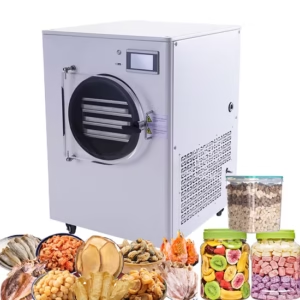
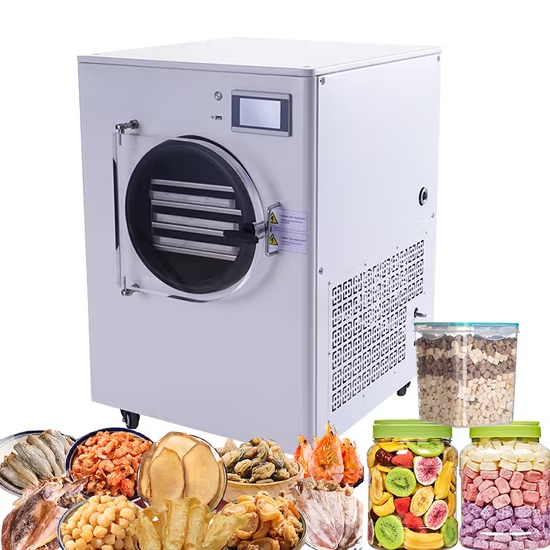
A freeze dryer machine typically includes:
- Vacuum chamber
- Refrigeration system
- Vacuum pump
- Product shelves or trays
- Heating system
- Temperature sensors
- Pressure monitoring
- Control panel
- Condenser or ice collector
The technology is used in food processing, pharmaceutical manufacturing, biotechnology, research laboratories and speciality product development.
2. Freeze Dryer Machine Price in India
The freeze dryer machine price depends on the equipment’s capacity, application, construction, refrigeration technology, automation and technical specifications.
Small laboratory systems generally require a lower investment than large industrial production units. Commercial food freeze dryers and pharmaceutical systems may require more specialised configurations.
The following are broad illustrative budgeting ranges for preliminary planning in India. They are not live quotations, verified supplier prices or guaranteed market rates.
| Machine category | Typical application | Indicative budget range |
|---|---|---|
| Small laboratory freeze dryer | Research and small samples | ₹2 lakh–₹8 lakh |
| Pilot-scale freeze dryer | Product development and trials | ₹8 lakh–₹25 lakh |
| Small commercial food freeze dryer | Startup food production | ₹15 lakh–₹40 lakh |
| Medium industrial freeze dryer | Commercial food processing | ₹40 lakh–₹1.5 crore |
| Large industrial freeze dryer | High-volume manufacturing | ₹1.5 crore–₹5 crore+ |
| Pharmaceutical freeze dryer | Pharmaceutical production | Project-specific; often several crores |
Actual pricing can vary substantially. Some laboratory systems may cost less or more than these illustrative ranges, while specialised pharmaceutical installations can require significant additional investment.
What affects the freeze dryer machine price?
Several technical and commercial factors influence the final quotation.
1. Processing capacity
Larger chambers and higher batch capacities generally increase equipment costs.
2. Shelf area
The total shelf area determines how much product can be loaded, subject to product thickness and loading requirements.
3. Refrigeration system
The cooling system must achieve the required freezing conditions and support the intended process.
4. Vacuum performance
Vacuum pump capacity, chamber design and vacuum-control performance affect the machine configuration.
5. Automation
Advanced PLC systems, programmable recipes and automated monitoring can increase the investment.
6. Material quality
Food-grade or pharmaceutical-grade construction requirements affect equipment specifications and costs.
7. Installation and commissioning
Freight, electrical work, installation, validation and operator training may add to the total project cost.
8. After-sales service
Warranty coverage, technical support and spare-parts availability should be included in the buying decision.
3. How Does a Freeze Dryer Machine Work?
Freeze drying uses a controlled combination of freezing, vacuum and heat transfer.
Step 1: Product preparation
Prepare the material according to the intended application. For fruits, this may include washing, peeling, cutting and sorting.
Step 2: Freezing
The product is frozen to a suitable temperature. The freezing conditions influence ice-crystal formation and can affect the final texture.
Step 3: Loading
The frozen product is placed on shelves or trays inside the freeze-drying chamber.
Step 4: Vacuum creation
The vacuum pump reduces chamber pressure to the required operating level.
Step 5: Primary drying
Controlled heat is supplied to the frozen product. Ice sublimates directly into water vapour, which is captured by a cold condenser.
Step 6: Secondary drying
Additional moisture is removed to achieve the required final product characteristics.
Step 7: Product unloading
The finished product is unloaded under suitable conditions to reduce exposure to moisture.
Step 8: Packaging
Freeze-dried products are packed in appropriate moisture-barrier packaging.
The complete cycle can take many hours and sometimes several days, depending on the product, loading, equipment and process specification.
4. Types of Freeze Dryer Machines
Different types of freeze dryers are available for specific industries and production requirements.
A. Laboratory freeze dryer
A laboratory freeze dryer is designed for research, testing and small-scale sample processing.
Applications:
- Biological samples
- Laboratory materials
- Research specimens
- Small food samples
- Product development
Key features:
- Compact design
- Small chamber capacity
- Controlled freezing and vacuum
- Monitoring of process conditions
B. Pilot-scale freeze dryer
Pilot-scale systems are used to test products and develop production processes before investing in larger equipment.
Applications:
- Food product development
- Process optimisation
- Recipe testing
- Small production trials
They help manufacturers understand cycle time, product quality and expected production yield.
C. Commercial food freeze dryer
Commercial systems are designed for businesses producing freeze-dried food products.
Applications:
- Freeze-dried mango
- Freeze-dried strawberries
- Freeze-dried pineapple
- Freeze-dried banana
- Freeze-dried vegetables
- Instant food ingredients
- Snack products
D. Industrial freeze dryer
Industrial freeze dryers are designed for larger production requirements. They may feature larger chambers, increased shelf area, advanced controls and automated loading systems.
Applications:
- Large food-processing facilities
- Ingredient manufacturing
- Speciality food production
- High-volume freeze-dried product manufacturing
E. Pharmaceutical freeze dryer
Pharmaceutical freeze dryers are designed for specialised pharmaceutical and biotechnology applications.
They may require:
- Controlled and documented processing
- Advanced instrumentation
- Validated cleaning procedures
- Sterility-related design considerations
- Regulatory compliance features
- Specialised commissioning and qualification
These machines should be selected according to the specific pharmaceutical process and applicable regulatory requirements.
5. Important Features to Check Before Buying
The lowest-priced machine is not necessarily the most economical choice. Buyers should evaluate the machine’s technical performance and suitability for the intended product.
1. Vacuum chamber quality
The chamber should be designed for the required operating pressure and application. Ask for material specifications and technical documentation.
2. Refrigeration performance
Check the freezing temperature range, cooling capacity and system reliability.
3. Vacuum pump
The pump should provide suitable vacuum performance for the intended chamber size and process.
4. Condenser capacity
The condenser captures water vapour during primary drying. Its capacity should match the product load and expected moisture removal.
5. Shelf heating and temperature control
Controlled shelf temperature is important for managing product temperature during drying.
6. Digital control system
A digital controller helps operators monitor temperature, pressure and process stages.
7. PLC automation
Industrial systems may include programmable logic controllers for repeatable processing cycles and automated monitoring.
8. Data recording
For businesses with strict quality requirements, process data recording can support documentation and traceability.
9. Easy cleaning and maintenance
Check accessibility, cleaning procedures and maintenance requirements.
10. Technical support
Confirm installation, operator training, warranty, spare-parts availability and service response times.
6. Freeze Dryer Machine Capacity: How Much Should You Buy?
Selecting the correct capacity is important for managing investment and production costs.
The capacity of a freeze dryer may be specified by:
- Total shelf area
- Fresh or frozen product loading capacity
- Maximum ice condenser capacity
- Batch capacity
- Chamber volume
These specifications are not interchangeable.
| Business requirement | Suitable equipment approach |
|---|---|
| Research and product testing | Laboratory freeze dryer |
| Recipe development | Pilot-scale system |
| Small packaged food brand | Small commercial system |
| Growing food manufacturer | Medium industrial system |
| Large-scale food production | Large industrial freeze dryer |
| Pharmaceutical manufacturing | Application-specific pharmaceutical freeze dryer |
Understand actual batch output
A machine advertised with a certain kilogram capacity may refer to fresh or frozen input rather than finished freeze-dried output.
Finished output depends on:
- Initial moisture content
- Product composition
- Preparation losses
- Product thickness
- Shelf loading
- Drying cycle
- Final moisture target
Ask the manufacturer to provide expected finished output for your specific product.
7. Freeze Dryer Machine for Different Food Products
Freeze drying is used for a wide variety of food products.
| Product | Common preparation | Commercial application |
|---|---|---|
| Strawberry | Whole or sliced | Snacks and cereal ingredients |
| Mango | Cubes or slices | Premium fruit snacks |
| Banana | Slices | Breakfast products |
| Pineapple | Chunks | Snack mixes |
| Apple | Slices or pieces | Cereal and bakery ingredients |
| Blueberry | Whole berries | Snack and ingredient markets |
| Raspberry | Whole berries | Premium toppings |
| Raspberry powder | Freeze-dried and ground | Food formulations |
| Dragon fruit | Cubes or slices | Speciality snacks |
| Coconut | Pieces or flakes | Bakery and food ingredients |
| Vegetables | Pieces or flakes | Instant foods |
| Herbs | Leaves | Speciality ingredients |
| Coffee | Extract | Instant coffee products |
Not every product requires freeze drying. For many conventional dried fruit products, hot-air or heat-pump drying may be more economical.
8. Freeze Drying vs Hot-Air Drying
Both technologies remove moisture, but their processes, investment requirements and finished product characteristics differ.
| Feature | Freeze drying | Hot-air drying |
|---|---|---|
| Main process | Sublimation under vacuum | Moisture removal using heated air |
| Product condition | Frozen during primary drying | Generally not frozen |
| Equipment cost | Usually higher | Generally lower |
| Drying time | Often longer | Product-dependent |
| Finished texture | Often lightweight and porous | Often chewy or firm |
| Product rehydration | Often rapid | Depends on product |
| Energy requirements | System-dependent and specialised | System-dependent |
| Common applications | Premium foods and specialised materials | Conventional dried foods |
Which technology should a business choose?
Choose freeze drying when the product specification and market justify the additional investment.
Consider hot-air drying when you want to manufacture conventional dried fruit products at a lower initial equipment cost.
A commercial trial and cost comparison should be completed before selecting either technology.
9. Electricity Consumption and Operating Costs
The freeze dryer machine price is only one part of the total investment. Operating expenses can have a significant impact on product economics.
Important operating expenses include:
- Electricity
- Refrigeration
- Vacuum pump operation
- Labour
- Cleaning and sanitation
- Packaging
- Maintenance
- Product testing
- Facility expenses
How to calculate electricity cost
Use this formula:
Electricity cost per batch = Average power consumption (kW) × Operating hours × Electricity tariff per kWh
Illustrative example:
- Average power consumption: 6 kW
- Operating duration: 24 hours
- Electricity tariff: ₹8 per kWh
Estimated electricity cost:
6 × 24 × ₹8 = ₹1,152 per batch
This is only an example calculation. Actual power consumption varies according to the refrigeration system, vacuum pump, heating system, product load, cycle duration and machine design.
Calculate the production cost per kilogram
Use this formula:
Production cost per kg = Total batch production cost ÷ Saleable finished output (kg)
Include raw materials, electricity, labour, packaging, maintenance, testing and other relevant expenses.
Because freeze drying can have long processing cycles, capacity utilisation is particularly important when evaluating profitability.
10. How to Start a Freeze-Dried Food Business
A freeze dryer can support a premium food manufacturing business, but commercial success requires more than purchasing equipment.
Step 1: Choose your business model
Decide whether you want to manufacture branded snacks, supply bulk ingredients, provide contract drying services or produce private-label products.
Step 2: Identify your target customers
Potential customers include:
- Premium snack retailers
- Health-food stores
- Supermarkets
- Online consumers
- Food manufacturers
- Cereal producers
- Bakery businesses
- Ingredient distributors
- Export buyers
Step 3: Select products
Start with a limited range based on raw-material availability, processing feasibility and customer demand.
Step 4: Conduct product trials
Test different product sizes, freezing conditions, shelf loading and drying cycles.
Step 5: Calculate the investment
Include machinery, installation, electrical infrastructure, storage, packaging, testing and working capital.
Step 6: Arrange the processing facility
Plan raw-material storage, washing, preparation, freezing, freeze drying, packaging and finished-product storage areas.
Step 7: Complete food business requirements
Identify applicable food-safety registration, licensing, labelling and manufacturing requirements.
Step 8: Develop packaging and branding
Freeze-dried foods are moisture-sensitive. Select packaging that protects the product from moisture and other quality risks.
Step 9: Build sales channels
Explore retail distribution, online marketplaces, wholesale supply, private-label production and export opportunities.
Step 10: Monitor profitability
Track processing yield, batch time, electricity use, labour, packaging cost and customer demand.
11. Packaging and Storage of Freeze-Dried Products
Freeze-dried foods are generally porous and can absorb moisture from the surrounding environment.
Poor packaging can cause loss of crispness, texture changes and reduced product quality.
Common packaging options
- High-barrier laminated pouches
- Aluminium foil barrier pouches
- Moisture-resistant sealed bags
- Food-grade rigid containers
- Suitable bulk ingredient liners
Important packaging considerations
- Moisture-barrier performance
- Oxygen protection where required
- Strong heat seals
- Food-grade packaging materials
- Suitable pack size
- Protection during transportation
- Accurate labelling
Desiccants may be suitable in certain packaging systems, provided they are food-safe, appropriately selected and used according to the packaging design.
Finished products should be stored according to validated product and packaging requirements.
12. Quality Control and Regulatory Requirements
Quality control is essential for commercial freeze-drying operations.
Businesses should establish procedures for:
- Raw-material inspection
- Product preparation
- Freezing conditions
- Shelf temperature monitoring
- Vacuum monitoring
- Drying cycle validation
- Final moisture testing
- Water-activity testing
- Microbiological testing where required
- Packaging inspection
- Batch documentation
- Storage monitoring
Food businesses in India
Food-processing businesses should identify applicable FSSAI registration or licensing requirements and comply with relevant manufacturing, hygiene and labelling regulations.
Businesses exporting freeze-dried products may also need to meet the destination country’s import, documentation and food-safety requirements.
Pharmaceutical applications
Pharmaceutical freeze dryers require a more specialised approach. Buyers should consider process validation, equipment qualification, documentation, cleaning requirements and applicable pharmaceutical manufacturing standards.
Do not assume that a food-grade machine is suitable for pharmaceutical manufacturing.
13. Freeze Dryer Machine Buying Guide: Questions to Ask Suppliers
Before purchasing a freeze dryer, compare manufacturers and request detailed technical specifications.
Important questions
- What is the maximum batch loading capacity?
- What is the total shelf area?
- What is the maximum ice condenser capacity?
- What is the minimum achievable condenser temperature?
- What vacuum level can the system achieve?
- What type of vacuum pump is supplied?
- What is the average electricity consumption per cycle?
- How long does a typical cycle take for my product?
- Does the machine include automatic controls?
- Is process data recording available?
- What material is used for the chamber and shelves?
- What is included in the warranty?
- Are installation and operator training included?
- What is the availability of spare parts?
- Can the supplier conduct a product trial?
Pre-purchase checklist
-
Define the intended application.
-
Estimate required batch capacity.
-
Confirm total shelf area.
-
Check condenser capacity.
-
Review vacuum pump specifications.
-
Confirm refrigeration performance.
-
Evaluate automation and controls.
-
Request a product trial.
-
Compare electricity consumption.
-
Confirm warranty and technical support.
-
Calculate the total installed investment.
-
Review cleaning and maintenance procedures.
A product trial using your actual raw material is one of the most useful ways to assess whether the equipment meets your production requirements.
14. Freeze Dryer Machine Manufacturers and Suppliers: How to Select One
Selecting the right manufacturer is as important as selecting the machine.
A reliable supplier should be able to explain the equipment’s technical specifications and demonstrate how the system performs with your product.
What to evaluate
Technical expertise: Check the manufacturer’s experience with the required application.
Product trial capability: Ask whether the supplier can conduct a freeze-drying trial.
Machine documentation: Request drawings, specifications, operating instructions and maintenance schedules.
Installation support: Confirm electrical, refrigeration and facility requirements.
Warranty: Understand which components and service activities are covered.
Spare parts: Check the availability and expected delivery time of essential components.
After-sales service: Confirm how technical support is provided after installation.
Avoid choosing a supplier only because its quotation is cheaper. A machine with unsuitable capacity, poor service support or inconsistent performance can increase long-term operating costs.
15. Business Opportunities with Freeze Dryer Machines
Freeze drying offers opportunities across several industries.
A. Freeze-dried fruit manufacturing
Produce freeze-dried strawberries, mango, pineapple, banana, blueberries and other fruit products.
B. Premium healthy snack brands
Develop lightweight, crunchy fruit snacks for retail and online customers.
C. Bulk food ingredient supply
Supply freeze-dried fruit pieces and powders to cereal, bakery, confectionery and food manufacturing companies.
D. Private-label manufacturing
Manufacture products for businesses that sell under their own brands.
E. Contract freeze-drying services
Provide processing services to food entrepreneurs, ingredient suppliers and product developers.
F. Instant food manufacturing
Freeze-dried ingredients can be used in selected instant meals, soups and speciality food formulations.
G. Pharmaceutical and biotechnology applications
Specialised freeze dryers are used in pharmaceutical and biotechnology manufacturing, subject to appropriate equipment design and regulatory controls.
H. Export-oriented production
Explore overseas markets for freeze-dried ingredients and premium food products while meeting destination-specific standards.
Business profitability depends on raw-material cost, processing yield, cycle duration, energy consumption, machine utilisation, packaging and market demand.