Commercial Fruit Dehydrator Machine: Price, Features, Types & Complete Buying Guide
The demand for dried fruits, healthy snacks and value-added food products is creating opportunities for food processing businesses. From dried mango and banana chips to dehydrated apples, strawberries, pineapples and vegetables, manufacturers need reliable equipment to produce consistent products on a commercial scale.
A commercial fruit dehydrator machine is an important investment for businesses looking to convert fresh fruits into dried ingredients and packaged snacks. It uses controlled heat, airflow and drying time to remove moisture from fruit while helping maintain the desired colour, flavour, texture and product quality.
Whether you are starting a small dried-fruit business, expanding an existing food processing unit or establishing an industrial dehydration plant, selecting the right machine can influence production capacity, operating costs and product consistency.
This complete guide explains machine types, prices, features, working principles, capacity, energy consumption, buying considerations, maintenance and business opportunities.
1. What Is a Commercial Fruit Dehydrator Machine?
A commercial fruit dehydrator machine is food-processing equipment designed to remove moisture from fruits under controlled drying conditions.
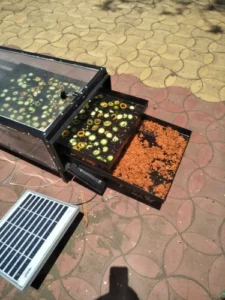
Unlike traditional sun drying, which depends heavily on weather and environmental conditions, a mechanical dehydrator provides a more controlled processing environment.
The machine generally uses:
- Heating elements or another controlled heat source
- Fans and air-circulation systems
- Food-grade trays or conveyor belts
- Temperature and time controllers
- Insulated drying chambers
- Moisture monitoring and quality-control procedures
The objective is to reduce the moisture content of fruit to a suitable level for the intended product and packaging.
A commercial unit can be used to process:
- Mango slices
- Banana chips
- Apple rings
- Pineapple pieces
- Papaya cubes
- Kiwi slices
- Strawberry pieces
- Pomegranate arils
- Coconut slices
- Orange slices
- Other fruits and vegetables
The right machine depends on the product, batch size, desired texture, final moisture specification and production requirements.
2. How Does a Commercial Fruit Dehydrator Machine Work?
A commercial dehydrator removes moisture through controlled drying. In a typical hot-air system, heated air circulates around prepared fruit, absorbs moisture and carries it away from the product.
Step-by-step working process
Step 1: Fruit selection
Choose fresh, mature and suitable-quality fruits. Remove rotten, damaged or unsuitable material.
Step 2: Washing and cleaning
Wash the fruits using appropriate food-processing procedures to remove dirt and surface contaminants.
Step 3: Peeling and cutting
Peel and slice fruits according to the required product specification. Uniform thickness helps improve drying consistency.
Step 4: Pre-treatment
Some fruits may require suitable pre-treatment to help manage browning, colour changes or texture. The method should be selected according to the product and applicable food regulations.
Step 5: Tray loading
Arrange fruit pieces in a single layer or according to the equipment manufacturer’s loading instructions. Avoid overcrowding because it can restrict airflow.
Step 6: Temperature and time setting
Select appropriate drying conditions based on fruit variety, slice thickness, initial moisture and desired final product.
Step 7: Moisture removal
The machine circulates controlled heated air through the drying chamber. Moisture gradually evaporates from the fruit.
Step 8: Cooling and quality inspection
Cool the dried fruit under hygienic conditions and inspect the texture, colour and moisture characteristics.
Step 9: Packaging
Pack the finished product in suitable food-grade moisture-barrier packaging.
The correct drying conditions must be established through product trials. One temperature and time setting will not work equally well for every fruit.
3. Commercial Fruit Dehydrator Machine Price in India
One of the most important considerations for a food-processing entrepreneur is the commercial fruit dehydrator machine price.
Machine prices vary according to tray capacity, drying technology, construction material, power requirements, automation and production capacity.
The following table provides broad indicative budgeting ranges for planning. These are not guaranteed market quotations or prices for specific machines.
| Machine category | Typical application | Indicative budget range |
|---|---|---|
| Small commercial tray dryer | Startup and small batches | ₹35,000–₹1,50,000 |
| Medium commercial dehydrator | Small and medium businesses | ₹1,50,000–₹5,00,000 |
| Large cabinet or industrial tray dryer | Higher-volume processing | ₹5,00,000–₹15,00,000+ |
| Heat-pump fruit dryer | Energy-conscious commercial production | Depends on capacity and configuration |
| Industrial conveyor dryer | Continuous production | Custom quotation |
| Industrial freeze dryer | Premium freeze-dried products | Often ₹20,00,000+ |
Prices are indicative and can vary considerably between manufacturers, specifications and installation requirements. Published Indian supplier listings show substantial differences between compact commercial units and larger industrial equipment. <Cite refs={[“turn961212search1″,”turn961212search3″,”turn961212search5″,”turn961212search12”]}/>
Factors that influence machine price
- Number and size of trays
- Batch capacity in kilograms
- Stainless steel grade
- Heating technology
- Fan power and airflow design
- Digital or PLC control system
- Temperature and humidity controls
- Insulation quality
- Automation level
- Installation, warranty and after-sales service
Buying tip: Always request a written quotation with machine specifications, GST, freight, installation, warranty and training costs listed separately.
4. Types of Commercial Fruit Dehydrator Machines
Different drying technologies are suitable for different products and production requirements.
A. Tray or cabinet fruit dehydrator
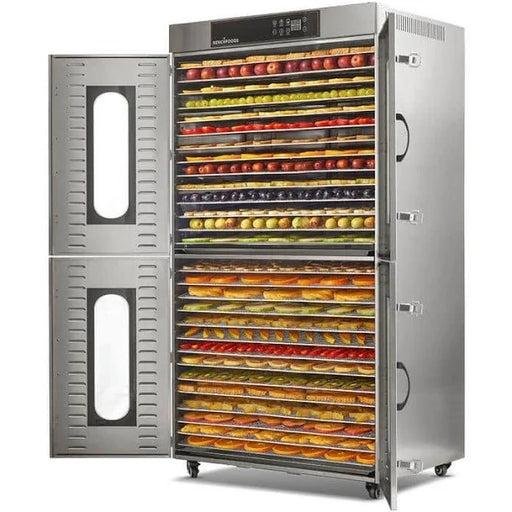
industrial stainless steel tray cabinet fruit dehydrator machine open door multiple drying trays” aspect Ratio=”16:9
This machine uses multiple trays arranged inside a cabinet. Heated air circulates through the drying chamber to remove moisture.
Best for:
- Dried mango
- Banana chips
- Apple slices
- Papaya
- Pineapple
- Herbs and vegetables
Advantages include relatively simple operation, flexible batch production and suitability for small and medium food businesses.
B. Industrial hot-air fruit dryer
large industrial hot air circulation food fruit drying machine stainless steel processing plant” aspect Ratio=”16:9″/>
An industrial hot-air dryer is designed for larger production requirements. It may include multiple chambers, improved insulation, industrial fans and advanced temperature controls.
Best for:
- Commercial dried-fruit production
- Food ingredient manufacturing
- Bulk fruit processing
- Contract drying operations
C. Heat-pump fruit dehydrator
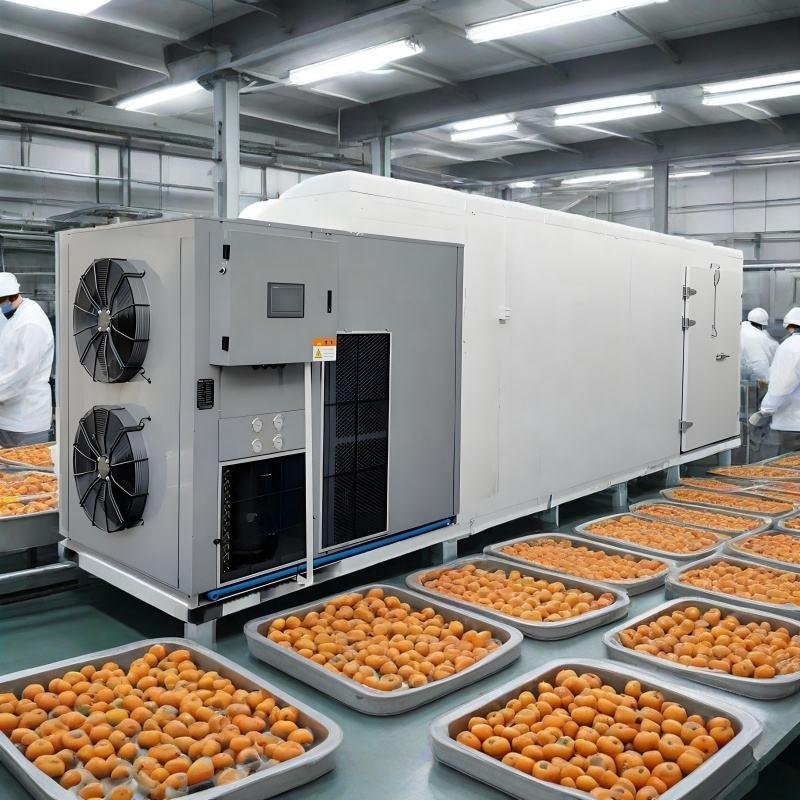
industrial heat pump food dehydrator fruit drying chamber machine” aspect Ratio=”16:9″/>
A heat-pump dryer uses refrigeration-based technology to transfer heat and manage moisture removal. Depending on the design, it can offer more controlled drying conditions and potentially lower energy consumption than some conventional systems.
Best for:
- Quality-focused fruit processing
- Products requiring controlled drying
- Businesses looking to optimise energy use
Compare the manufacturer’s measured energy consumption under comparable operating conditions before selecting this technology.
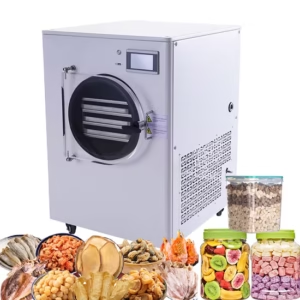
D. Freeze dryer machine
industrial freeze dryer machine stainless steel food processing freeze drying chamber” aspect Ratio=”16:9″/>
Freeze drying removes ice from frozen products under vacuum through sublimation.
It is used for premium products where maintaining a lightweight, porous structure and distinctive texture is important.
Best for:
- Freeze-dried strawberries
- Freeze-dried mango
- Freeze-dried pineapple
- Freeze-dried berries
- Premium fruit snack ingredients
Freeze dryers usually require higher investment and more specialised operating procedures.
E. Continuous conveyor fruit dryer
=”industrial continuous conveyor belt fruit dehydrator drying machine stainless steel food factory” aspect Ratio=”16:9″/>
A conveyor dryer moves products through controlled drying zones on a belt. It is designed for continuous or large-scale production.
Best for:
- Large food-processing plants
- Standardised product lines
- High-volume fruit and vegetable drying
5. Important Features to Check Before Buying
The best machine is not necessarily the one with the most features. It is the machine that consistently meets your product specifications at a sustainable operating cost.
1. Food-grade stainless steel construction
Check which parts come into contact with food. Stainless steel grades such as SS 304 are commonly specified for food-contact applications, while some environments may require other materials.
Ask the manufacturer to identify the material grade of the chamber, trays, racks and food-contact surfaces.
2. Uniform hot-air circulation
Airflow is essential for consistent drying. Poor circulation can cause uneven moisture removal, with some pieces becoming too dry while others remain too moist.
3. Adjustable temperature control
Different fruits require different drying conditions. Select a machine with an appropriate temperature range and accurate control.
4. Digital timer and controller
Digital controls help operators repeat validated drying programmes and reduce manual monitoring.
5. Programmable PLC system
Larger machines may use a programmable logic controller (PLC) to manage operating stages and drying settings.
6. Energy-efficient heating
Heating and fan systems contribute to operating expenses. Compare actual power consumption per batch and energy use per kilogram of finished product.
7. Proper insulation
Good insulation helps reduce unwanted heat loss and maintain stable chamber conditions.
8. Easy cleaning and maintenance
Look for removable trays, accessible filters, hygienic construction and cleaning-friendly chamber designs.
9. Safety features
Check for electrical protection, over-temperature protection, suitable wiring and emergency controls where applicable.
10. After-sales service
Confirm warranty coverage, spare-part availability, installation support, operator training and service response times.
6. Commercial Fruit Dehydrator Machine Capacity
Choosing the correct capacity is essential. A machine that is too small may restrict production, while an oversized unit may increase capital and operating costs unnecessarily.
| Business size | Possible equipment configuration | Suitable operation |
|---|---|---|
| Startup | Small tray dryer | Pilot batches and market testing |
| Small business | Multi-tray commercial dryer | Regular retail production |
| Medium business | Multiple cabinet dryers or larger batch dryer | Wholesale and contract processing |
| Large manufacturer | Industrial drying system | High-volume production |
| Large-scale plant | Continuous drying line | Standardised industrial output |
Understand batch capacity and finished output
A machine advertised with a 100 kg batch capacity may refer to the fresh product loaded, not the weight of dried fruit produced.
Fresh fruit contains a large amount of water. The final dried output depends on:
- Initial fruit moisture
- Desired final moisture
- Peel and seed removal
- Cutting and preparation losses
- Drying efficiency
- Rejected or damaged pieces
Ask the manufacturer to conduct a trial using your actual fruit and provide the expected fresh input, finished output and processing time.
7. Commercial Fruit Dehydrator Machine for Different Fruits
A versatile dehydrator can process several types of fruit, but the operating conditions and preparation methods differ.
| Fruit | Typical preparation | Commercial applications |
|---|---|---|
| Mango | Peeled slices | Dried mango snacks |
| Banana | Slices | Banana chips and snack mixes |
| Apple | Rings or slices | Breakfast and bakery ingredients |
| Pineapple | Rings or chunks | Dried fruit snacks |
| Papaya | Cubes or strips | Snack mixes |
| Strawberry | Halves or slices | Cereals and toppings |
| Kiwi | Slices | Premium dried fruit |
| Orange | Slices | Garnishes and bakery |
| Coconut | Slices or shreds | Bakery and snack ingredients |
| Pomegranate | Extracted arils | Snack and ingredient products |
For each fruit, establish suitable preparation, loading density, temperature, drying time and final moisture specifications through controlled trials.
8. Commercial Fruit Dehydrator Machine vs Traditional Sun Drying
Traditional sun drying is still used in some food-processing operations. However, it depends on environmental conditions and requires careful protection from contamination.
| Feature | Traditional sun drying | Commercial dehydrator |
|---|---|---|
| Drying source | Sunlight and ambient conditions | Controlled heat source |
| Weather dependency | High | Lower |
| Drying consistency | Can vary | More controllable |
| Production planning | Seasonal limitations | More flexible |
| Environmental exposure | Requires protective measures | Enclosed processing chamber |
| Temperature control | Limited | Adjustable in suitable models |
| Batch management | Manual | More systematic |
| Initial investment | Usually lower | Higher |
A mechanical drying system can improve process control, but it does not automatically guarantee food safety. Hygienic preparation, validated processing, moisture control and suitable packaging remain essential.
9. Electricity Consumption and Operating Cost
The purchase price is only one part of the investment. Electricity, labour, maintenance, packaging and raw materials affect the total cost of production.
How to estimate electricity cost
Use this simple calculation:
Electricity cost per batch = Average power consumption (kW) × Operating hours × Electricity tariff per kWh
For example, assume a machine uses an average of 4 kW, operates for 10 hours and the electricity tariff is ₹8 per kWh.
Estimated electricity cost:
4 × 10 × ₹8 = ₹320 per batch
This is an illustration, not a consumption guarantee. Actual power use depends on heating cycles, insulation, ambient temperature, product load, fan operation and equipment design.
Other operating expenses
- Fresh fruit purchase
- Sorting and preparation labour
- Electricity or fuel
- Cleaning and sanitation
- Packaging materials
- Quality testing
- Repairs and spare parts
- Transport and warehousing
Calculate the cost per kilogram
To estimate production economics:
Total batch cost ÷ Saleable dried output (kg) = Production cost per kg
Include all relevant costs and use the actual saleable output rather than the fresh fruit input.
10. How to Start a Dried Fruit Business Using a Commercial Dehydrator
A commercial fruit dehydrator can be the foundation of a value-added food business.
Step 1: Select your product range
Start with products that match local fruit availability and customer demand.
Examples:
- Dried mango
- Banana chips
- Dried pineapple
- Dried apple
- Dried papaya
- Mixed dried fruit packs
Step 2: Research the market
Identify potential buyers such as supermarkets, health-food stores, bakeries, online customers, wholesalers and food manufacturers.
Step 3: Conduct product trials
Test different fruit varieties, slice thicknesses, drying conditions, packaging and taste preferences.
Step 4: Choose suitable equipment
Select a machine based on actual production needs, not only advertised capacity.
Step 5: Arrange food-processing infrastructure
Plan washing, cutting, drying, cooling, packaging and storage areas. Follow applicable food-safety and licensing requirements.
Step 6: Develop packaging and branding
Create suitable packaging with accurate ingredient information, net weight, batch details, dates, storage instructions and other required declarations.
Step 7: Establish sales channels
Explore:
- Retail distribution
- Online marketplaces
- Your own e-commerce website
- Wholesale supply
- Private-label manufacturing
- Food ingredient distribution
Step 8: Monitor profitability
Track raw-material cost, drying yield, energy use, labour, packaging, rejected batches and selling price.
11. Food Safety, Quality Control and Certifications
Food-processing businesses should make food safety a priority from raw-material sourcing through finished-product dispatch.
Important areas include:
- Hygienic fruit washing and handling
- Suitable water quality
- Clean food-contact surfaces
- Pest-control procedures
- Foreign-material control
- Validated drying process
- Moisture and water-activity testing
- Microbiological testing where appropriate
- Suitable packaging and storage
- Batch identification and traceability
In India, food businesses must identify and comply with applicable FSSAI registration or licensing requirements. Businesses targeting export markets may also need to meet destination-specific standards and buyer requirements.
Potential quality-management frameworks and certifications to investigate include:
- HACCP-based food-safety systems
- ISO 22000
- Relevant GMP practices
- Buyer-specific audit requirements
Certification requirements depend on the business, market and product. Do not assume that purchasing a machine automatically makes a processing unit compliant.
12. Commercial Fruit Dehydrator Machine Buying Guide
Before placing an order, compare at least two or three manufacturers.
Essential questions to ask a manufacturer
- What is the fresh fruit batch capacity?
- What is the expected dried output for my selected fruit?
- What is the average electricity consumption per batch?
- Is the chamber made from food-grade stainless steel?
- Is the airflow uniform across all trays?
- Can the temperature and time be programmed?
- Can I test the machine with my own raw material?
- What is the warranty period?
- Are spare parts readily available?
- Does the supplier provide installation and training?
- What are the cleaning and maintenance requirements?
- What is the total installed cost?
Pre-purchase checklist
-
Define the fruit products you will manufacture.
-
Estimate daily fresh-fruit processing volume.
-
Confirm expected dried output.
-
Check tray dimensions and loading capacity.
-
Review material specifications.
-
Compare energy consumption.
-
Request a product trial.
-
Check warranty and after-sales service.
-
Confirm installation and freight costs.
-
Obtain a written technical quotation.
13. Commercial Fruit Dehydrator Machine Manufacturers and Suppliers
When searching for a commercial fruit dehydrator machine manufacturer, compare suppliers based on technical capability and service support.
A good equipment supplier should be able to provide:
- Detailed technical specifications
- Machine drawings and dimensions
- Material-grade information
- Capacity and performance details
- Product trial facilities
- Installation guidance
- Operator training
- Warranty documentation
- Spare-parts support
14. Commercial Fruit Dehydrator Machine: Business Opportunities
The growth of dried fruit ingredients and packaged snacks creates several potential business models.
A. Dried fruit manufacturing
Purchase fresh fruits, process them and sell finished dried products under your own brand.
B. Contract dehydration services
Offer drying services to fruit growers, food brands and ingredient suppliers.
C. Wholesale dried fruit supply
Supply bulk dried mango, banana, apple, pineapple and other products to distributors and food manufacturers.
D. Private-label production
Manufacture dried fruit products for retailers and businesses that sell under their own brands.
E. Export business
Explore overseas markets for dried fruit products, subject to product specifications, food-safety requirements, documentation and import regulations.
F. Food ingredient manufacturing
Supply dried fruit pieces to bakeries, cereal producers, confectionery manufacturers and snack companies.
G. Processing machinery business
Businesses with engineering and manufacturing capabilities can explore equipment fabrication, installation, servicing and spare-parts supply.
Commercial success depends on sourcing, quality, production economics, distribution and customer demand. A machine purchase alone does not guarantee profitability.